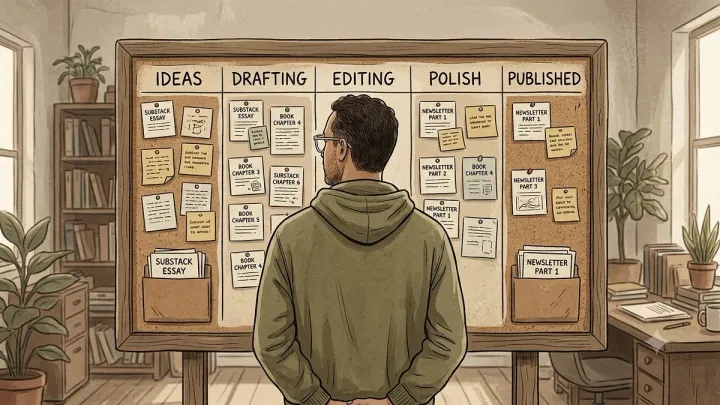
Today I sat down to sort out my whole Substack process. Not to write anything. Just to organise it. Templates, tidy folders, a checklist so nothing slips through. I’m only new to writing on Substack and wanted to know if what I’m doing is efficient or whether there was a better way to do things.
As I contemplated what to do the question I had when I sat down “how do I make this more efficient” changed to “What processes do I have now that I can get wrong and undo in seconds versus those that I’m stuck with if a break it”.
To answer that, I used Claude and built an AI workflow tool combining two frameworks I’d been ruminating on. The first was the Toyota Way, the carmaker’s famous system for hunting down and avoiding waste. The second, Amazon Jeff Bezo’s test for decisions: a two-way door, the one you can walk back through; or the one way do you end up stuck with.
I pointed Claude at my Substack process. When it was done, did I feel criticized? Yes, however the critique was fair and implemented it. It told me what to keep, what to drop and where to focus. Here’s how it went:
A rule we should repeat
“Do it right the first time” is the ideal, and at Toyota it comes from the factory floor. Its foundation is built around removing waste. Every wasted movement, every half-finished job sitting in a pile, every fault that causes a redo. On a production line, it creates loss, in time and resources. A mistake is expensive: scrapped materials, retooled machines, defects shipped to customers. When errors cost millions, you embed structures and processes to avoid them.
I took that idea and pointed it at my own work. Create a lean workflow, avoid noise and focus on what needs to be done. It seems obvious but it’s easy to focus on the next thing and when you lose focus mistakes happen creating waste.
Fortunately, this aspect of the workflow was already working smoothly and didn’t require any fixes. My Substack is not a car factory, when something goes wrong it costs me time and that’s all. My niche generative AI accelerates any corrections.
The question that actually tested by workflow
The test is simple: can you walk it back in seconds, or are you stuck with the result that costs you time and trust?
Most of what I do turned out to be two-way doors, but I had a single one-way door that I needed to resolve. Here is what I found.
Start with images in my articles. For my article on rebranding a cafe from three photos I built a set of before and after comparison pictures. This was a completely new workflow that I had no method for. I spent hours searching how to format them, link the photos and manage the files. This was two-way door: always redo able. It cost me time, because I had no system in place, but it can be reworked and changed.
Another example is my website. I was adding a page for my growing set of tools so new subscribers could access them. I built the tools page before deciding how it should function; then I had to rebuild it. That was time wasted due to failing to ask a simple question: what is the page for and what will it contain? It was easy to walk back, a prompt to Claude to adjust the site and it was resolved in minutes.
The one part I stopped doing, making short versions of every post. Somewhere along the way I had thought I might need them. However, making them for every post was a waste, so I walked them back.
The one-way door I didn’t know I had
What surprised me was that I had one at all. My short tenure of writing and an absence of embedded habits have created a flexible workflow in the upstream. What I hadn’t considered was downstream. The place where my work reaches real people and a mistake has consequences.
My one-way door was my subscribers
When someone subscribes, I promise a free download, or a link that carries them to it. Alter my website, move files carelessly and new subscribers end up with a broken link or nothing at all. A broken promise to a new subscriber is something I can’t take back.
I fixed it or more precisely I used AI to fix it. I gave every download one permanent link, pointed wherever the file lives. Move the file and I update a single place, not ten, so a reader never lands on nothing. I keep a simple map of what points where and I check it before I change anything.
There you have it. A short list of two-way doors and an important one-way door. This process it part of a Thinking with AI kit I use. The other two are the interview and the council that a central to yourself. This one ran on something outside of me, my actual workflow, and it caught a problem I couldn’t see.
The questions you should keep
You don’t need my workflow or my tools to use any of this. You need one question asked before you start tidying, planning, or building anything:
How expensive is this to reverse?
If it’s cheap, skip the planning: make the rough version and adjust if it fails. Speed beats care.
If it’s expensive, you need to slow down and do it properly. Bring a checklist and take time to review.
For you
This is the third of the three ways I’ve been using AI to provide direction, feedback and improvement. The first was to make AI interview me so I could better understand myself. The second was to put a real decision in front of a panel of five advisor and let them debate your decision. This is a great skill to provide a different perspective whether designing a logo, an outfit choice or a holiday destination.
The last piece is this one, I turned it into two AI prompts, the first I call the Lean Sensei. You describe something you are about to build or organise. The second is Reversible or Not? Card and help identify where you shoud stop planning and just try or slow down.
Thanks for reading! I build things with AI and share what I learn as I go. Subscribe. It’s Free. Subscribe on Substack.