
Everyone who’s unsure about their career looks for an answer online, and AI can be one of those answers. You get a response that sounds well-rounded. Give it a specific role instead, and you realise the first answer was an educated people pleaser, not an expert.
Starting the interview, I didn’t have an objective. No thoughts of future career options, no additional education underway, just a slight restlessness that my current role wasn’t for me long term. That’s a terrible brief for a single AI to run. Ask it to interview you, research the market, audit your skills, and plan your network, and it will hand back a cohesive answer with no value.
I originally ran the interview from a single prompt and soon realised my error. I’m not a career advisor, but I do know my industry, and my first thought was: why isn’t it telling me what I already know, and filling in the gaps of what I don’t? So I split the job across four: one to interview, three specialists to guide me, each with a narrower job and no permission to blur into the others.
The interview framework became a diagnostic inquiry: unpack the motivation first, then explore the facts, timeline, qualifications, contradictions between what I said and what I actually felt. It was framed to prevent premature conclusions, so the career plan came from my own feedback, not assumptions made by the AI.
Once that was established, the interview stopped and the panel started.

Specialist one: the rehab consultant
Their task: break the target role into its foundational, micro-level components. Not the job title, the actual underlying skills: stakeholder negotiation, causal analysis, planning, documentation, whatever the role really requires. Then check the person’s real history against each component individually. This is where new, previously unnamed capability shows up: someone can lack the job title but have all the skills to perform the job. Any gaps that show up can be identified and a plan can be put in place to address it.
Specialist two: the personal brand strategist
Their task: write one clear, specific value-proposition statement per pillar, what makes this exact person worth choosing over another candidate with the same credential, based on their actual interview responses.
Three different pillars, three different jobs, and tenure decides which one applies:
- Staying, with real tenure: the job is repositioning an existing reputation.
- Staying, but newly arrived (under about a year): there’s no reputation to reposition yet. The job is establishing one, deliberately and early.
- Leaving: the job is a stranger’s first impression, scanning a CV in seconds.
Check actual tenure first. The first two need opposite actions.
Specialist three: the networking strategist
This part is required, not optional with four parts outlined to support personal and career development:
- Named, dated events: actual conferences or industry gatherings in this specific field, not “an industry event.”
- A professional association matched to the specific pillar and geography, not a generic national body if a sharper, more specific one exists.
- A real LinkedIn strategy: who specifically to search for and connect with, a connection-request opener built from the value proposition above (personalised requests meaningfully outperform generic ones), and an actual posting and engagement cadence.
- A concrete approach to asking for informational interviews: lead with something specific, not a blank ask for a job.
Each specialist was asked to use live web search where available: real postings, real salary bands, real events, and to say plainly when something comes back thin rather than guess minimising hallucinations. Without live search, each was asked to state this and flag that market data or requirements are from training knowledge and may be outdated. At no time were they to guess with the same confidence as a researched fact.
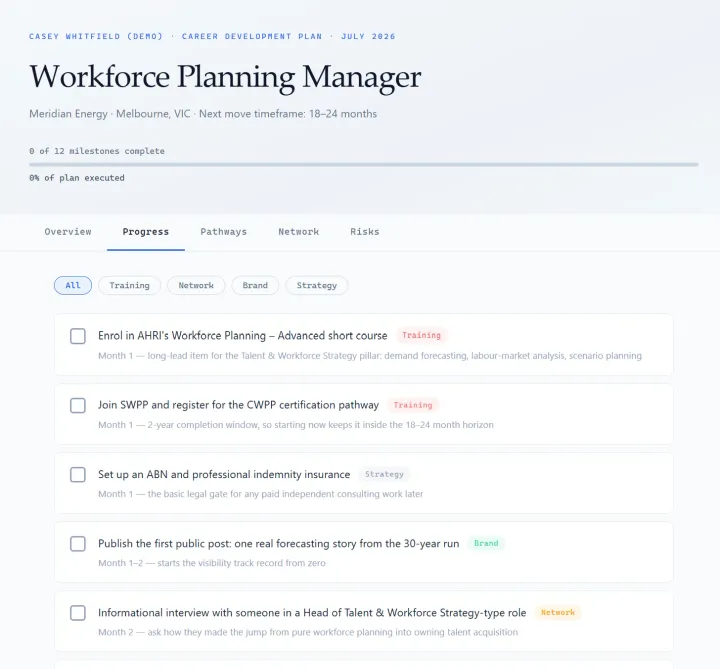
Once each specialist finished, the panel produced an interactive tool.
Follow the link to check it now: Interview Career Plan
Run it yourself
The interview and the three specialists were built in Claude and can be run from a single prompt. Download the skill, with every rule included, as a free printable kit. If you use Claude Code, get the full version on GitHub and import it to run the whole panel automatically. Just say “interview me.”
Thanks for reading. I build with AI and share what I learn as I go. Subscribe. Its Free Subscribe on Substack.