
This build will not save you a single minute. It won’t streamline a workflow or automate a report.
But it’s fun, and it’s simple to make. It’s a party game, built from a handful of plain-English prompts, and what comes out the other side is a working interactive tool that runs in a browser, on your work computer or your mobile phone.
And building it taught me more about prompting than most of the productivity experiments I’ve run this year.
The game
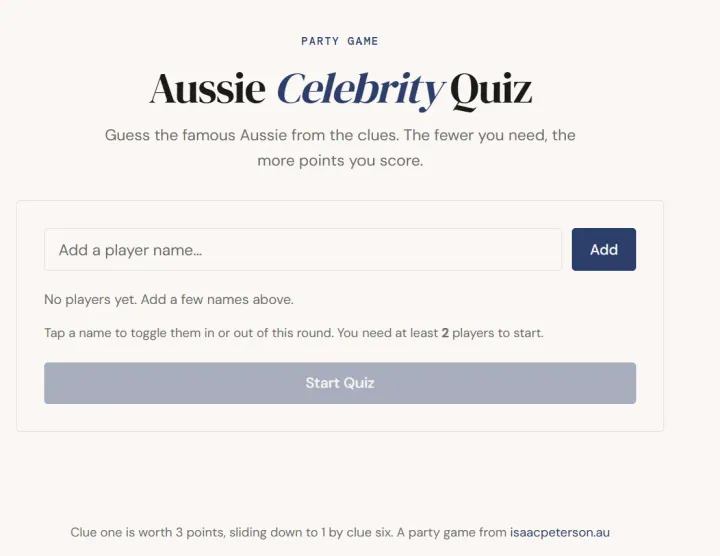
It’s called the Aussie Celebrity Quiz. One web page. No app, no login, no accounts.
It’s live right now: aussie-celebrity-quiz.netlify.app
The rules take ten seconds to explain:
-
One person hosts. Everyone else shouts answers.
-
The screen reveals clues about a famous Aussie, hardest first.
-
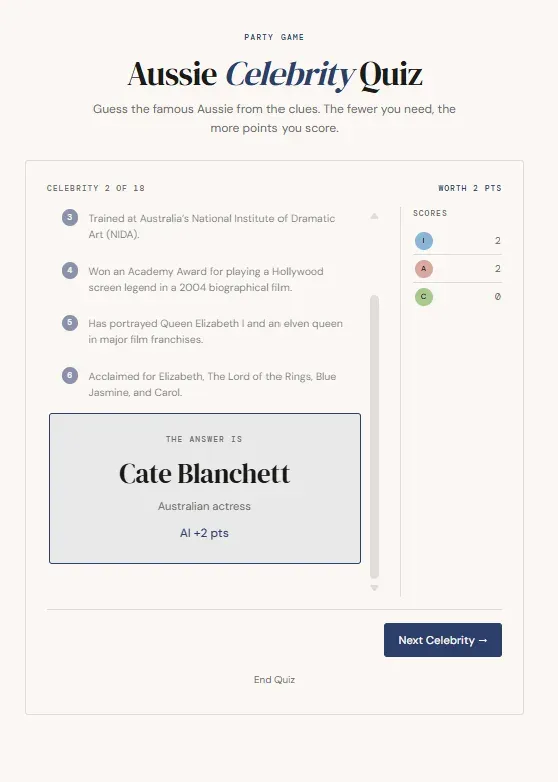
Guess on clue one, score 3 points. Wait until clue six, score 1.
-
First to call it gets the points. Highest score wins.
Eighteen celebrities, from Bradman to Margot Robbie. A lobby for player names, a live scoreboard, a winner’s screen. It runs off a phone in the middle of the table.
Built inside the corporate fence
Here’s the part that matters. I didn’t build this with a developer setup. I built it with Microsoft Copilot Cowork, the AI I use at work to update documents.
That’s what it gets asked for, most days. Update the policy doc. Pull the numbers into a summary. Redraft the report that came back marked up. Useful, beige, forgettable.
The same tool that updates your documents will build you a working game. The limitation was not knowing that this could be done at work.
Why pointless builds are the best training
There’s a real argument under the fun, and it’s this: low-stakes builds are the cheapest AI training you will ever get.
Think about what a build like this actually does:
-
Writing a spec. You have to describe the game before the AI can build it.
-
Iterating. The first version is never right. You review, you correct, you resend.
-
Quality judgement. Clue three spoils the answer. A fact is wrong. You catch it.
-
Shipping. Getting a real thing in front of real people, even if the stakes are a laugh.
What it also shows is how much workplace software has changed. You are no longer stuck with what the tool ships with. Think a little outside the box, describe what you’ve imagined, and the AI your workplace already provides will build it for you: a one-of-a-kind presentation, a game, whatever the job actually needs.
The five prompts
Here’s the structure, prompt by prompt. Swap “Aussie celebrities” for anything: 90s music, football players, your industry’s in-jokes, your own family.
Prompt 1: the founding prompt. Describe the whole game in one message:
Build me a party quiz game as a single HTML file. Players guess a famous Australian celebrity from six clues, revealed one at a time, hardest clue first. Guessing early earns more points: 3 for clue one, sliding down to 1 by clue six. Include a lobby where I add player names, a button to award points to whoever guessed it, a running scoreboard, and a final winner screen. It needs to look good on a phone.
Prompt 2: the content engine. The game is only as good as its clues:
Generate 18 famous Australian celebrities across acting, music, sport and TV. For each, write six clues ordered hardest to easiest. Clue one should be obscure biography only a superfan knows. Clue six should be a giveaway. Never mention the name or their most famous role before clue five. Verify every fact.
Prompt 3: the flow check. Make the AI walk the game as a player:
Walk through one full round as if you’re the host. Describe every screen, every button press, and every score change from lobby to winner. Flag anything confusing or broken.
Prompt 4: the hostile playtest. My favourite prompt in any build:
Act as a harsh play tester. Find every clue that gives the answer away too early, every fact that’s wrong, and every screen that’s awkward on a phone. List the problems first, then fix all of them.
Prompt 5: the polish. Make it yours:
Restyle the whole game: [your colours, your fonts, your vibe]. Don’t touch the game logic.
Five prompts. That’s the skeleton. Everything after you adjust to get it right.
Make it yours, then set it free
Mine didn’t stay a Copilot draft. I brought it home, restyled it to match my site, and put it on the internet for free.
Hosting cost: $9 a month. A single HTML file drops straight onto Netlify and I use Claude to deploy it, and you get a link anyone can open. Mine now lives with the rest of my builds at isaacpeterson.au.
That last step matters more than it looks. A file on your laptop is a toy. A link you can send is a product. Even when the product is a party game.
Take home lesson
Nothing about this was productive. That was the assignment.
But what I just walked you through is the same process I used to build other tools, career plans, newsletters and websites. It’s what built my NSW Reform Navigator, the tool an agency would have quoted six figures for. The serious build and the silly build are the same skill.
So this weekend, or this lunch break, build something useless. Your grandmother’s trivia. A quiz for the group chat. Something that makes six people laugh at a barbecue. I’ve been thinking about a Pun Generator, purely to get a few laughs.
You’ll come out the other side better at the serious stuff. The fun is the training.
If this made you want to build something dumb, two asks: subscribe so the next build lands in your inbox, and send this to the designated quiz person in your life. They know who they are.
Thanks for reading. I build with AI and share what I learn as I go. Subscribe. Its free. Subscribe on Substack.