I used Claude to analyse two affidavits for a legal case. It produced a report identifying inconsistencies in the respondents’ evidence, disputed facts, and the contribution of the witness affidavit to a favourable result.
On face value it was positive and that was where a seed of doubt crept in. It was too positive and that’s where a proceeded to craft a prompt that found hallucinations. The prompt is attached for download; it will work across all queries and outputs.
The dangerous hallucinations are opinions filed under “verified facts.”
Most people picture an AI hallucination as a fake court case with a made-up citation. The dangerous ones are harder to spot.
The dangerous ones look exactly like facts.
AI can take the title of an article and confidently invent a 1500-word opinion piece about content it never read. I watched it happen in a real one. Here’s what it looked like, why it happens, and the skill that caught it.
Why AI invents facts that sound true
Start with the mechanism, because it explains everything.
A language model doesn’t look up facts. It predicts words. When you prompt it, it calculates the most statistically probable next sequence of text, not the true one. Fluency is the goal. Accuracy is a side effect.
That’s why the output is so dangerous when it’s wrong. The model will weave plausible connections between things that were never connected, because coherent language is its only directive.
In professional work, that shows up as:
- Code that’s syntactically perfect and logically broken.
- Market stats attributed to sources that were never real.
The bias hiding in a legal brief
The setting was family law witness preparation, ahead of a court date. An AI built a consolidated summary from two sworn affidavits: the applicant’s witness, and the respondent’s denials.
It looked clean. It was not.
Sitting inside the “verifiable facts” section were claims that were nothing of the sort:
- One party’s interpretation of why someone helped them, presented as documented fact.
- A guess about someone’s motive for moving cities, written as if proven.
- Editorial commentary arguing certain payments “weren’t consistent with friendship.”
- A phrase from the other side reframed as a “tacit admission”: a legal argument.
Better prompts help, but they don’t finish the job
The first line of defence is prompting like you’re handing over an assignment, not asking a question.
- Ground it. by giving the model source material and requiring answers only from that.
- Role-play. Define hard boundaries: “You are a compliance officer; responses must follow these rules.”
- Constrain it. Fewer words, fixed format, tight scope. The narrower the instruction, the less room to invent.
This reduces errors, but the deeper problem remains.
A well-grounded prompt still produced that biased legal summary, because the bias wasn’t a made-up fact. It was interpretation, and interpretation slips past a good prompt.
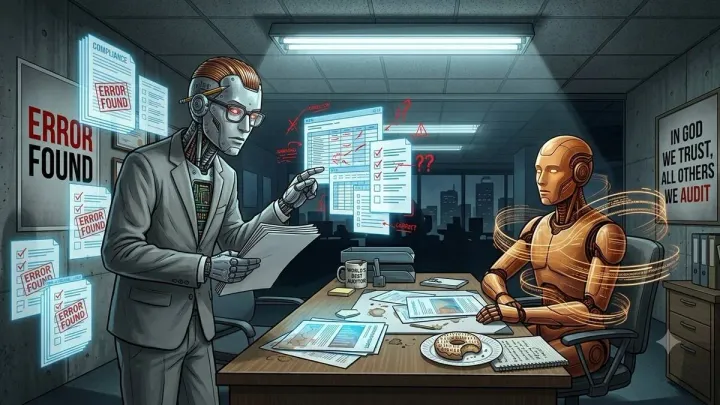
The fix: point a second AI at the first
The catch wasn’t better proofreading. It was appointing an auditor.
A second AI was pointed back at the document with one job: assume the report is biased and prove it. It flagged every one of those items: the motives, the commentary, the second-hand claims narrated as verified evidence.
Then the document was rebuilt. Every line was reframed as “the Witness states” or “the Respondent states.” Contested claims got flagged inline. The advocacy was stripped out of the “facts.”
The prompt is the whole trick
The auditor only worked because of how it was told to look. Not “check this.” Three specific attacks:
- False positives: find interpretations, emotion, or one party’s viewpoint masquerading as cold fact.
- Extract validation gaps: find claims the source doesn’t fully support without the AI connecting dots that weren’t connected.
- Re-classification: move anything that’s one party’s claim out of the “fact” section and into “contested.”
That’s the reusable move. The auditor prompt isn’t a question. It’s an assignment to attack. Run it against any AI output where being wrong actually costs you.
Because the lesson from that document holds everywhere: honesty about what’s second-hand doesn’t weaken your work. Overclaiming does, and your AI will overclaim for you unless something is built to catch it.
I’ve put the exact auditor prompt into a one-page kit you can save and paste. Grab it here, free:
Download: Quiet Tools 01 Ai Auditor (PDF)
Thanks for reading. I build with AI and share what I learn as I go. Subscribe. It’s free. Subscribe on Substack.