When I started on Substack, I used AI to analyse just over 200 AI-industry Substack notes, and I found a clear winner. Notes that opened with a bold, declarative claim beat everything else. I’d found the golden ticket and proudly started using it as my engagement strategy.
Ten days and a few notes later, scrolling feeds across different topics, something felt off. The established writers I was following weren’t using bold statements.
So I asked the question: is this metric valid, should I analyse more notes? The answer wasn’t about the number of notes. It was the number of writers I’d reviewed. Three. My “golden ticket” was three people with a habit, not a winning pattern.
I analysed ten more writers. Bigger names balanced so no single account could dominate. A thousand notes in total.
My finding vanished entirely. The bold claim effect went from strong to zero. So did every other thing I tested: how long the note is, whether it asks a question, whether it has a link, whether it’s a list. All of it, noise.
Here’s what I learned.
Who wrote the note matters more than the note
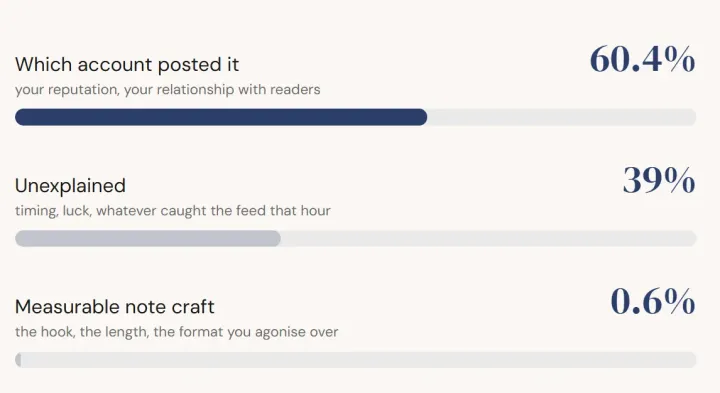
Engagement comes down to who wrote the note, not its structure or format. Across a thousand notes, note craft accounted for 0.6% of engagement.
You are the variable that actually moves engagement.
Two currencies, and why both will humble you
I asked the better question: what about accounts with lots of subscribers?
Likes and restacks work as two separate currencies. Substack has a growth-and-engagement crowd, writers whose whole thing is helping you grow. They accumulate enormous likes and very few restacks. Their audience likes back because being liked back is the deal. It’s called reciprocal engagement.
Then there are writers who post something genuinely worth forwarding: far fewer likes, far more restacks. A like costs a tap; a restack shares value.
Justin Wolfers was the clearest example in the data. Per 100 likes, he gets 21 restacks. Seven times the growth crowd. His notes have no set formula: length varies, some have attachments, some don’t. What he has instead is that he’s a domain expert. People follow him for his expertise, and they share his expertise. The note is just the delivery.
And if you write in a niche like AI, the raw numbers are sobering. A smaller account gets roughly one like per thousand followers on a note, and it gets worse as you grow. A huge AI account can be down at one like per ten thousand. The engagement rate doesn’t climb with your audience; it falls. You cannot build your motivation on it. (I haven’t measured other niches, so this figure is specific to AI.)
The take-home: you need a third currency
Likes and restacks are both external, decided mostly by things you don’t control, and in a niche like mine (AI) they’re tiny. If you’re three weeks in with a handful of followers and you’re reading your like count as a scoreboard, you’re grading yourself on the one number the data says is mostly noise. Your niche might never hand you a social-media endorphin hit. The dopamine machine most social media platforms are plugged into barely turns over in my niche.
You need a third currency. One that’s internal and doesn’t depend on your audience size.
Mine is simple: I like problem solving, AI helps me do that quickly, and I get a kick out of it. If I gained likes, restacks, and subscribers, that’s a bonus I’d be happy with. I ran this whole analysis to fix a problem. “How to optimize notes to get more subscribers”. Expecting a simple formula, and there wasn’t one.
Your niche might never hand you a social-media endorphin hit. You need a currency it can’t take away.
Yours might be different: a single reply from one real person who says it helped; your craft getting sharper; the archive of things you’ve made that exist whether or not anyone clapped. Pick the one that’s true for you and make that the scoreboard.
Build the currency that fuels the other
The internal currency is the only fuel for the external one. That 60.4% is your brand. What you mean to the people who read you. It isn’t built by chasing likes. It’s built by making things worth making, over and over, until the account becomes the thing that carries the note. The growth crowd calls this “consistency,” and they’re right about the behaviour; consistency compounds into your 60.4%.
Find your third currency and build it. Everything else is just noise. Because in the end, the most important metric isn’t your likes, restacks, or subscribers. It’s the score you’ve chosen to keep.
Thanks for reading! I build with AI and share what I learn as I go. Subscribe it’s free.